
Neurology and spinal surgery in India
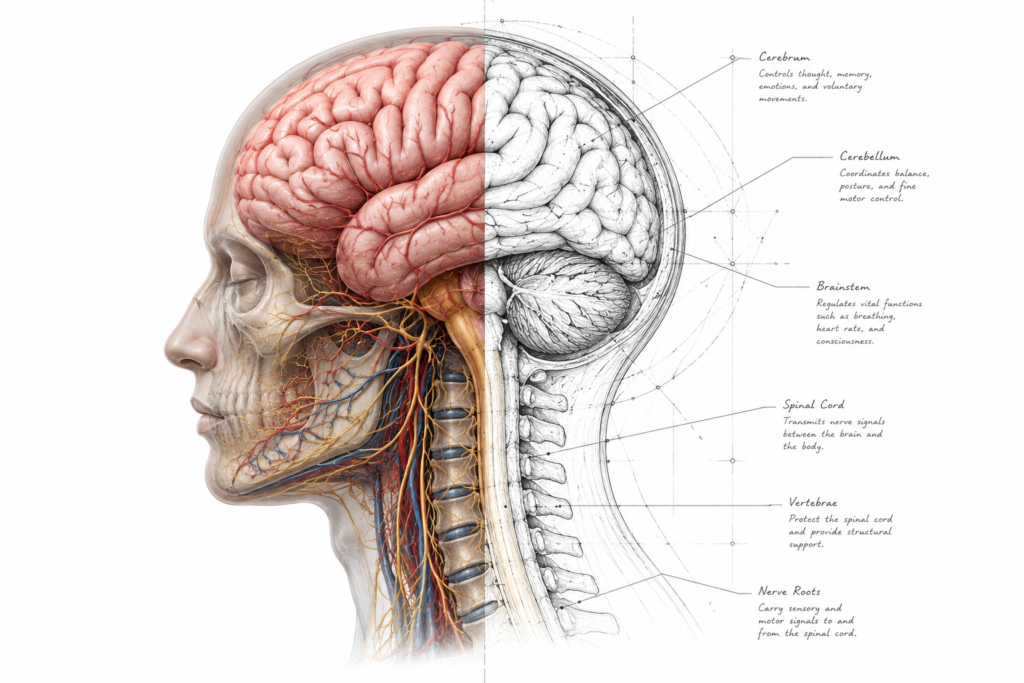
Considering neurology and spinal surgery in India? Here's what you should know about conditions, treatment advances, and what to expect.
The brain and spinal cord together form the central nervous system — the command centre for everything your body does. Every movement you make, every sensation you feel, every thought you have passes through this system. When something goes wrong inside it — a tumour pressing on brain tissue, a slipped disc compressing a spinal nerve, a bleed into the brain — the effects can be sudden and severe.
Neurological surgery is among the most technically demanding fields in medicine. The margin for error is small, the anatomy is complex, and the stakes are high. This is precisely why the advances of the last 20 years matter so much. Intraoperative MRI allows surgeons to take real-time images of the brain during an operation, confirming how much tumour has been removed without waking the patient. Neuronavigation systems work like GPS for the brain, mapping the exact location of surgical instruments in three dimensions. Endoscopic techniques allow surgeons to reach deep structures — pituitary tumours, for example — through the nose, without making any incision in the skull at all.
For spinal conditions, the shift toward minimally invasive surgery has been equally significant. A procedure that once required a long open incision in the back and days in hospital can now often be done through cuts smaller than a centimetre, with patients walking the same day and home the next morning.
Neurosurgery is expensive everywhere. A brain tumour operation in the United States can cost $50,000–$200,000 depending on complexity and hospital. Spinal fusion surgery runs $60,000–$150,000. In India, the same procedures — performed by neurosurgeons with equivalent training, using the same imaging technology and surgical equipment — cost a fraction of that.
Beyond cost, there is the question of access. In many countries, a referral to a neurosurgeon involves a wait of weeks or months, followed by further delays for diagnostic scans and specialist review. For conditions that are progressive — a growing tumour, a worsening disc herniation with nerve damage — that timeline can mean the difference between a good outcome and a worse one.
India's leading neurosurgical centres operate at very high volume, which matters. Surgical outcomes in complex brain and spine procedures improve significantly with the number of cases a surgeon has performed. Many of India's senior neurosurgeons have performed more complex craniotomies and spinal reconstructions than their counterparts in smaller Western hospitals simply because the caseload is larger.
Post-operative care after neurology and spinal surgery in India is equally rigorous. Patients recovering from spinal fusion or microdiscectomy are guided through structured physiotherapy programs before discharge, with clear milestones for movement and activity. For neurosurgical patients, follow-up imaging confirms healing progress before you're cleared to fly home, and your surgical team remains reachable for questions during recovery — whether you're still in India or back home.
Each treatment below has its own page explaining exactly what the procedure involves, what to expect before and after, and a full cost breakdown. Click "View details" on any row to read more.